Feb 28, 2011

The Passing of Former Met of the Day: Greg Goossen (1965-1968)

This weekend the Mets family has lost yet another player from the sixties. Greg Goossen passed away at his home in Sherman Oaks, California, he was 65.

Gregory Bryant Goossen was born on December 14, 1945 In Los Angeles, California. He attended Notre Dame High School in Sherman Oaks and was a star baseball player. He was originally signed as an amateur free agent in 1964 by the home town Dodgers but was released the next year.

The Mets picked him up on waivers and he hit .305 in 1965 in the New York / Penn. League. He made his MLB debut as a September call up in 1965 at the age of 19. He got two hits in each of his first two MLB games, and hit his first MLB HR in Philadelphia on his next to last game of the season.

He batted .290 in only 11 games, the best average he would hit for in his Mets career. Casey Stengel made a remark about Ed Kranepool & Goossen saying “See that guy there, (Kranepool) in ten years he has a chance to be a star. There we have a fine young catcher who is only nineteen years old. In ten years he has the chance to be twenty nine”.

He spent 1966 in the minors where he hit well; earning another September call up, this time he only batted .188 in 13 games.

That month he caught the first game Nolan Ryan ever pitched, and was later honored in 1992 at a Nolan Ryan ceremony in Texas. He hit one more HR that month; it would be his last as a Met. In 1967 he was aboard for the whole season as one of three backups behind Jerry Grote, but he only hit .159 in 37 games.

He followed with a .208 average in 1968 playing in 38 games, with seven doubles & six RBIs. By 1968 Grote was an All Star and J.C. Martin had arrived as his back up. Not that Martin was a good hitter either but the Mets chose him over Goossen & had their eyes set on Duffy Dyer for the future. Gossen was traded to the expansion Seattle Pilots for cash and as the player to be named later, in July they received Jim Gosger.

Goossen enjoyed his best season in 1969 playing first base & outfield as his catching days were behind him. He enjoyed career highs in batting (.309) HRs (10) RBIs (24) Hits (47) and games played (52). He was mentioned many times as a subject who could laugh at himself in Jim Bouton’s book Ball Four.

He went with the team to Milwaukee and briefly played as an original Brewer before being purchased by the Senators. He was sent to the Phillies for Curt Flood but never played at the big league level. Lifetime in six seasons he had 111 hits, batted .241 with 13 HRs 24 doubles & 44 RBIs.

Retirement: After baseball Goossen had a bust life, first he became a private detective. Then he was a corner man in the boxing ring, working with his two brothers who were pro boxers. Since then he has enjoyed a life in Hollywood. He plays the stand in for actor Gene Hackman in over a dozen films including roles in Get Shorty, Behind Enemy Lines & Mr. Baseball.

"We met when I was managing boxers with my brothers, and Hackman was doing research for the 1988 film "Split Decisions. He just took a liking to me; we just got along very well. He took care of this old, befuddled, used-up baseball player."

In February of 2011, Goossen was to be inducted into the Notre Dame High School Hall of Fame. When he missed a photo shoot a family member went to check on him & found him passed away. Cause of death yet to be determined; he was survived by three dughters, seven brothers & two sisters.

Feb 16, 2011

Italian / American Inventor of the Pitching Machine: Lorenzo Ponza:
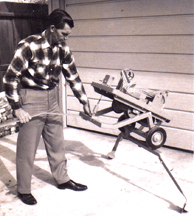
Lorenzo Ponza was born on February 15, 1918 the son of Italian immigrants Lorenzo and Mary Ponza, in Glenwood California. He grew up on his parents Saw Mill & worked in the engineering field after high school. He moved to Pearl Harbor in 1941 working for the Navy & was there during the 1941 Japanese bombing attacks. He remained in Hawaii becoming a civil supervisor helping build up the US Pacific Fleet.


He came back to Santa Cruz in 1950 & opened up a small machine shop working as an inventor. By 1952 he gets credit with inventing the modern day baseball pitching machine. He fine tuned some of the older original models that never quite resembled real life pitching.(Another Italian inventor Paul Giovagnoli also developed a similar machine that year & his company claims they invented the first.)


But the Ponza machines, known as “ponzas’ among the base ball players were the most widely used & most authentic. Through the years Lorenzo followed up with many improvements to his pitching machines & owns seven different baseball product patents.


There was the 1974 Hummer, which could simulate fastballs, pop-ups and grounders, the 1983 Casey, the 1987 Ponza Swing King and the 1988 Rookie. He eventually sold his company to the Athletic Training Equipment Company in the early 1990s.

Mr. Ponza was a big San Francisco Giants fan, & had a room dedicated to mementos & letters from various baseball players. Being such a bust worker, he attended few games because he didn’t have the time.Lorenzo Ponza passed away from cancer in in 2004 at age 86 in California.

Feb 4, 2011

The First Met's Owner & Woman Pioneeress: Joan Whitney Payson (1962-1975)

Joan Whitney Payson was born on February 5, 1903 in New York City. She was an heiress to the prominent Whitney Family and received much of the fortune when her father passed on. She would marry Charles Shipman Payson, a lawyer and successful businessman himself. The two lived in a 50 room mansion in Manhasset, NY with their own private art gallery.

She collected art and has many notable works donated in her name at the NY Metropolitan Museum of Art, in the Joan Payson Galleries. She along with her brother also ran Green Tree Stable & Breeding Farms in Saratoga NY & Lexington Kentucky. Their horses won four Belmont Stakes, two Kentucky Derby’s & a Preakness. The family interests also backed finances for Broadway plays & movies, including A Streetcar Named Desire & Gone With the Wind.

Mrs. Payson was a huge baseball fan and became a minority holder in the New York Giants baseball club. Her favorite player was Willie Mays. She voted against the Giants move to California, and sold her shares when they left. She began to work hard to find a replacement team.

In 1962 she became the first woman in America to buy a majority share of a sports team. She was the Mets majority stock holder, team President and was involved in baseball operations from 1962-1975. Unfortunately she trusted M. Donald Grant with many decisions in the later years. Her husband Charles Shipman had no interest in baseball. She loved her team, and was good to her players. They also had a deep respect and admiration for her.

She was always seen in the front row of Shea Stadium rooting on her team, not in an owner’s box. In 1972 she got Willie Mays back to New York to finish his career as a New York Met.

After her passing in 1975, her daughter inherited the team; Lorinda De Roulet.

She knew nothing about baseball either, and along with M. Donald Grant they destroyed the organization for the next few years.

They sold their shares in 1981 when the Wilpon/ Doubleday ownership took over.

Feb 3, 2011

Bob Murphy's Brother Jack Murphy & the San Diego Stadium Named After Him

Jack Murphy was born on February 5,1923 in Oklahoma.
He is the older brother of legendary New York Mets broadcaster Bob Murphy.

Beginning in 1951, Jack was a sports writer & editor for the San Diego Union news paper for the next thirty years.

In the early sixties he began a push to get a professional multipurpose sports facility to the San Diego area. Murphy then helped lure the AFL football Chargers from the Los Angeles area, south to San Diego.

In 1967 the Chargers played the first ever game in the new 54,000 seat stadium which would eventually be home to both the Padres & Chargers.

In 1969, Murphy was instrumental in bringing the San Diego Padres from the Pacific Coast League to the major leagues in the expansion of the National League.


The stadium located in Mission Valley, was originally named San Diego Stadium & after his passing in 1980 it was renamed San Diego’s Jack Murphy Stadium in his honor. It soon became simply known as “the Murph”. The stadium originally was a horse shoe shape, like the Polo Grounds, but with three tiers and a large scoreboard in the center of the open air space.

By 1997 the entire stadium was enclosed all around, the first of the square-circle "octorad" style, stadiums which was an improvement over the cookie cutter style.

The stadium has hosted the 1978 & 1992 All Star Game, three Super Bowls (XX11, XXXII & XXVII) as well as the 1984 & 1998 World Series. It also is home to the San Diego State University Aztecs college football team & hosts the Pacific Life Holiday Bowl and the San Diego County Credit Union Poinsettia Bowl in December.

In 1997 the Stadium was renamed Qualcomm Stadium in a time where corporate sponsorship began to take over ball parks.

Mets announcer Bob Murphy, always referred to the place as Jack Murphy Stadium during Mets broadcasts until his retirement in 2004. Many San Diegoians still call it that, the area around Qualcomm is called Jack Murphy Field.

I was at Qualcomm Stadium in 2003, the Padres last season there before moving to the beautiful Petco Park in 2004. First off San Diego is probably the most beautiful city in the United States, with its miles of gorgeous Pacific Ocean beaches, Mission Bay & the modern metropolitan down town area. The main area downtown is the historic Gam Lamp Quarter which is filled with restaurants, bars & an amazing outdoor open air mall. The 16 block area was revitalized with the building of Petco Park, which saw hotels, condo’s & new business build up all around the area. On our second trip to San Diego in 2006, we stayed on Coronado Island which is a resort paradise of its own. The island is one of the most expensive places in the country to live & is home to a US Navy base which trains the Navy Seals.


PETCO PARK