Matthew Shane Ginter was born on December 24th, 1977 in Lexington, Kentucky. The six foot one, righty attended Mississippi State University. He was one of four first round pitchers chosen by the Chicago White Sox in the 1999 amateur draft. Ginter had pitched in the 1998 Baseball World Cup earning a save with a 5.40 ERA. He went through the White Sox minor leagues & by 2000 he was 11-8 at AA Birmingham posting a 2.25 ERA.
He debuted in the majors that September actually earning a win against the Anaheim Angels in his first game, pitching a scorless inning. In his next appearance he blew a save allowing four runs on two hits in just one inning. In 2001 he was picked as the best prospect in the Sox organization by Baseball America. He was caled up in June & made twenty appearances as a middle reliever going 1-0 with a 5.22 ERA.
He spent two more seasons in Chicago making 33 appearances in 2002 but just three the next year in 2003. That off season he was traded to the New York Mets for Timo Perez. He began the year at AA Norfolk & would go 1-5 there with a 2.95 ERA during the season.
He got to the Mets club by May 16th, debuting in Houston getting the start against Roger Clemmens pitching into the 6th inning but earning no decision. He left the game behind 2-0 buy a 9th inning Mike Piazza HR off Octavio Dotel tied it & the Mets won it in the 13th on a Jason Phillips HR. In his next appearance he allowed five runs but beat the Colorado Rockies 9-7 at Shea Stadium earning his only win as a Mets pitcher.
He would take a loss to Cleveland on June 16th as the Indians scored five runs off him in an inter league game at Shea. A week later he was knocked out in the third inning across town by the A.L. New York team in a Mets subway series loss. Ginter made 15 appearances for the Mets going 1-3 with a 4.54 ERA, 38 strike outs 20 walks in 69 inning spitched. On April 5th of the 2005 he was sent to the Detroit Tigers for Steve Coyler who never pitched in a Met uniform.
Ginter only played in 15 games there becoming a free agent at the end of the year. He signed with a bunch of teams but didn't see any big league action until 2008 with the Cleveland Indians where he went 1-3 in four starts. In his seven year career he was 5-7 with 132 strike outs 75 walks one save a 5.43 ERA in 232 innings pitched over 96 games.
Hobert Neal Landrith was born on March 16, 1930 in Decatur, Illinois. His family moved to the Detroit area where he & his six brothers took turns holding the catching position at their local high school. While still in high school he got the opportunity to go to Briggs Stadium (aka. Tiger Stadium) and warm up Tiger starting pitchers. He also helped Bronx born Tiger player, Hank Greenberg get back into shape after returning from military service.
Hobie went on to attend Michigan State University, playing as a star catcher for the Spartan’s baseball team. At the age of 19 he was signed by the Cincinnati Reds. At Spring Training he became a highly touted prospect, but rumors came about that he wanted to play for only his hometown Tigers. The Tigers & Reds both made offers to him but he still remained with the Reds.
He debuted briefly in 1960 & then spent six seasons in Cincinnati as a backup catcher, behind Andy Semenick & Smokey Burgess. In 1953 he got the Opening Day start against the Brooklyn Dodgers & although he drove in two runs, he allowed a passed ball in the 9th inning which won Brooklyn the ball game. That year the All Star Game was held in Cincinnati & the NL manager, Brooklyn’s Charlie Dressen, chose Landrith to catch batting practice.
In 1956 Landrith moved to the Chicago Cubs, playing as the teams main catcher batting .221 with three HRs & a career high 32 RBIs. Behind the plate he led the league throwing out 23 bases runners attempting to steal, a 38% average overall. He allowed ten passed balls & made 14 errors which was the most of all NL backstops.
In December 1956 he was traded with Sam Jones, Jim Davis, and Eddie Miksis to the St. Louis Cardinals for Ray Katt, Jackie Collum, and Tom Poholsky. He played in St. Louis for two seasons behind main catcher Hal Smith. From there he was traded to the San Francisco Giants for Marv Grissom & Ernie Broglio. He played with the Giants from 1959-1961), playing as a regular there in 1959 hitting .251 with 3 HRs 14 doubles & 29 RBIs. That year he posted the league's second best fielding % for catchers (.992%) & caught 51% of the runners trying to steal on him (4th best in the NL).
In 1961 Landrith made New York Mets history as the first pick in the teams’ 1961 expansion draft. Manager Casey Stengel said of the pick; " you have to have catchers or you're going to have a lot of passed balls". Landrith was behind the plate & hit in the number eight position in the first Mets game ever played on April 11, 1962 in St. Louis. He signaled to Roger Craig for the first pitch in the bottom of the 1st inning & later went 0-4 at the plate during the game.
He had an early six game hit streak putting him over the .400 mark ten games into his season. On May 12th 1962, Landrith had his shining moment as a Mets player in the first game of a double header at the Polo Grounds. He hit an exciting 9th inning pinch hit, walk off HR off Milwaukee’s Hall of Famer Warren Spahn. That gave him a stretch of driving in runs in three straight games he had played in. In the second game of that same double header, Gil Hodges hit a walk off game winner making it a very exciting day for the ’62 Mets fans.
Landrith had a two hit game in Los Angeles against the Dodgers, then saw his average fall under .300 in the first week of June. He would only play 23 games with the Mets, hitting .289 (13-45) with three doubles, one HR, seven RBIs & a .389 on base %. Defensivley he played in 21 games, throwing out 3 of 15 base runners trying to steal, posting a .968 fielding %. He made three errors in 93 chances. On June 7th he was traded to the Baltimore Orioles for Marvelous Marv Throneberry, who was to become the Mets first folk hero type player.
Landrith’s likeable personality and abilities as a quality backup catcher kept him in the majors for 14 seasons. He finished his career in 1963 with the Washington Senators. He appeared in 677 games behind the plate, posting a .983 fielding %, making 59 errors in 3459 chances. He threw out 40% of would be base stealers (137 out of 339 attempts). He hit .233 with 450 hits 34 HRs 69 doubles 253 walks 203 RBIs & a .320 on base % playing in 772 overall games.
Retirement: After his playing days, he coached with the Washington Senators for one season then left baseball. He became a car salesman in Northern California, eventually becoming the director of sales for over forty Volkswagen dealerships.
Harry Hunter Wendelstedt Jr. was born July 27th 1938 in Baltimore Maryland. He began umpiring in the major leagues in 1966 for the National League. Wendelstat was famous for having a wide strike zone, he would shout & use the now famous so called "chain saw move" on a called third strike. If it was a swinging strike he would raise his right arm straight up in the air signaling the out.
In 1968 he made a controversial call in favor of Dodger pitcher Don Drysdale which helped him continue his scoreless innings streak to his record 58 2/3 innings. San Francisco Giants batter Dick Dietz was hit in the elbow with a pitch & if he had gotten to first base a run would have scored. But Wendelstedt ruled Dietz made no attempt to get out of the way, Drysdale's streak continued on.
On April 22, 1970 Wendelstedt was behind the plate at Shea Stadium when Tom Seaver struck out 19 San Diego Padres tying a major league single game strike out record. In that game Seaver struck out the last ten batters he face setting another record.
Wendelstedt worked his first World Series in 1973, between the New York Mets & the Oakland A's. He was the home plate umpire in Game #6 at the Oakland Coliseum in a game where Catfish Hunter beat Tom Seaver 3-1 to even the series at three games each.
The next time the Mets were in the World Series, 1986 Wendelstedt was once again on the umpiring staff. He worked the plate in Game #6 at Fenway Park in the Mets 7-1 victory over the Red Sox. In that game Lenny Dykstra led off the game with a HR, Gary Carter drove in three runs & the Mets first designated hitter Danny Heep drove in two runs. In that game Bob Ojeda beat Oil Can Boyd.
Two years later Wendelstedt was on the umpiring staff of the NLCS in which the Dodgers beat the Mets in seven games. He was behind the plate in Game #1 where Dwight Gooden went up against Orel Hershiser, neither pitcher fgured in the decision as the Mets won it in the 9th inning on Daryl Strawberry & Gary Carters doubles.
Overall he worked in seven NLCS series & five World Series serving as crew chief in 1980 & 1995. He also worked a record tying five no hitters & four All Star games.
In 1977 he took over the Al Somers Umpire School & renamed it the Harry Wendelstedt Umpiring School serving as the chief instructor there for 17 years. His son Harry Hunter Wendlestat goes by the name Hunter & wears the uniform #21 just like his dad in his honor. The two became the first father & son umpire team to work a game together in 1988. Wendelstedt Sr. was diagnosed with a brain tumor ten years ago & passed away this week at Ormond Beach Florida at the age of 73.
__________________________________
Donald Ray Mincher was born on June 24th 1938 in Huntsville, Alabama. The six foot three first baseman was signed by the Chicago White Sox in 1956. In 1960 he was traded along with Earl Battey to the Washington Senators for Roy Sievers. After one season the franchise moved to Minnesota & became the Twins. He played six seasons with the Twins having his best seasons in the mid sixties. In 1965 Mincher hit 22 HRs with 17 doubles 65 RBIs batting .251 with a .344 on base % helping the Twins get to the World Series .
That year he led the AL in intentional walks (15) and was one of the hitting stars of a Twins team that featured six time HR champion Harmon Killebrew, three time batting champ Tony Oliva, & that years MVP Zolio Versalles. In the first game of the 1965 World Series Mincher hit a HR off Don Drysdale in the Twins 8-2 win. The Dodgers would win the Series in seven games coming from behind down two games to none.
In 1966 he was part of a record setting inning in which five Twins players hit HRs, the game was on June 9th against the Kansas City A's. Mincher would move on to play for the California Angels (1967-1968) then the Seattle Pilots in their only season of existence 1969.
That year he was the teams power hitter with 25 HRs & 78 RBIs. As the franchise moved to Milwaukee Mincher was sent to the Oakland A's where he played in 1970-1971 & then returned to close out his career there at the end of the 1972 season. In between his stints with the A's he played in Washington & then in Texas when the team moved there in 1972. Mincher appeared in three games of the 1972 World Series driving in a run in his only at bat. He went out a winner as his A's beat the Cincinnati Reds in seven games.
In his 13 year career Mincher hit .249 with 1003 hits 200 HRs 176 doubles 643 RBIs & a .348 on base %. He played in two All Star games (1967 & 1969) & was among the leagues top four first baseman in fielding four times. After his playing days he was general manager of the Huntsville Stars a AA affiliate of the A's & Milwaukee Brewers. He also served as President of the minor leagues Southern League from 2000-2010. He passed away on March 4, 2012 after a long illness.
Albert Francis Gionfriddo was born on March 8th, 1922 in Dysart, Pennsylvania. The Italian American outfielder served in World War II returning to debut with the Pittsburgh Pirates in 1944 for just four games.
In 1945 he would be the Pirates regular outfielder, on the fourth place club, in his only full season. He hit .284 striking out just 22 times in 406 at bats, hitting 2 HRs with 42 RBIs 18 doubles 9 triples (6th in the league) & 74 runs scored. He stole 12 bases (10th in the league) while posting a .376 on base %.
In 1947 he was traded to the Brooklyn Dodgers along with $100,000 for five players including future MLB manager Gene Mauch. He would play just one season in Brooklyn but that’s where he would be forever remembered. On the regular season he only hit .177 with six RBIs in 37 games, but it was in the World Series where he became a hero.
In Game #4 of the 1947 World Series, the AL New York teams pitcher Bill Bevan had a no hitter going into the 9th inning. Carl Furillo walked and Gionfriddo came in to pinch run for him. After another walk, Cookie Lavagetto got the first & only Dodger hit of the game. the hit scored Gionfriddo as well as Furillo for the dramatic Brooklyn victory.
In Game #6 the Dodgers were leading 8-5 in the 6th inning when Gionfriddo was brought in as a defensive replacement to play left field. With two men on base, Joe DiMaggio blasted a shot to the 415 foot mark in deep left center field. Gionfriddo raced across the field and reached over the fence to make the catch robbing Dimaggio of a HR. Gionfriddo’s hat flew off, and DiMaggio in a rare show of emotion kicked the dirt while approaching second base.
In the Series Gionfriddo went hitless in three at bats, but stole a base, scored two important runs, plus made one of the top catches in World Series history. The next season he was back in the minors & spent nine years there as a player, before becoming a minor league manager.
In his brief four season MLB career he played in 228 games batting .266 with 154 hits two HRs 58 RBIs 22 doubles & 12 triples.
Retirement: He retired from pro ball by 1960 and became a scout for the Cincinnati Reds. He was an athletic director in Santa Barbra California & opened a restaurant there as well. He suffered a heart attack & passed away while playing golf in Solvang California in 2003, at the age of 81.
Jeffrey Franklin Kent was born on March 7, 1968 in Bellflower, California. In high school he had a serious run in with his baseball coach which got him removed from the team. He then attended the University of California (at Berkley) playing for the Golden Bears.
The six foot one right hand hitter, was drafted by the Toronto Blue Jays in the 20th round of the 1988 draft. He played three brief seasons in the minors, showing power hitting 16 HRs in 1990 at AA ball.
He got onto the Blue Jays Opening Day roster in 1992 debuting on April 12th getting his first career hit that day, a 6th inning double. Two days later he hit his first career HR off Lee Gutterman & the A.L. New York club. In 1992 he played 65 games for Toronto hitting 8 HRs with 35 RBIs and batting .240, through the end of August. On August 27, 1992 Kent & Ryan Thompson were traded to the New York Mets in the trade for pitcher David Cone.
Kent debuted at Shea Stadium on August 28th in a double header against the Cincinnati Reds. He went hitless in the first game, then in the second game had two hits & drove in three runs. Three days later he hit his first Mets HR,while playing both ends of another double header against the Atlanta Braves. Kent refused to be treated as rookie when arriving in New York, not participating in any hazing that went on to initiate rookies. He insisted his rookie status was left behind in Toronto. Although he angered some of his team mates he did show class by moving over to short stop at the end of the season, allowing Willie Randolph to play his final career game at second base.
In 37 games as a Met he would hit .239 with 3 HRs 8 doubles & 13 RBIs. Kent would become the Mets primary second baseman for the next three & a half seasons, through 1996.
He began 1993 slow hitting just .213 in April & having hit just two Hrs through May. He didn't hit for a high average but his power numbers & run production picked up in the summer. At the start of the month he had two games where he drove in three runs & during a ten game span from July 17th through the 27th, Kent drove in runs in eight games. In mid August he drove in runs in five of eight games, hitting HRs in consecutive games on August 21 & 22.
In September he drove in twenty runs including RBIs in his last five games of the season. On September 10th Kent drove in four runs against the Chicago Cubs with three hits & a HR. On September 26th he hit a grand slam HR against the Montreal Expos, driving in five runs leading the Mets to a 9-3 win. Three days later in a classic 17 inning pitcher's duel, Kents walk off base hit won it for the Mets off the St. Louis' Cardinals pitcher Les Lancaster. In his first full season with the Mets he hit 21 HRs second on the club to Eddie Murray. Kent hit 24 doubles driving in 80 runs with seventeen multi RBI games, while batting .270.
In 1994 on Opening Day he had four hits, including a three run HR at Wrigley Field helping the Mets to a 12-8 victory over the Cubs. He drove in a pair of runs in his first three games of the year & had a huge April with 8 HRs 26 RBIs, finishing the month batting .375 placing him amongst the tops in the N.L. In May he remained hot, going into the first week of June batting .323 with 11 HRs. In June he hit safley in 17 of twent games raising his average above .300.
On July 22nd he hit a grand slam against the San Francisco Giants at Shea leading the Mets to a 6-3 win. In an eight game stretch in mid June he drove in runs in all but one game for a total of eleven RBIs. The seasons ended in early August due to a baseball strike & Kent finished with 14 HRs & was pretty much the team’s offensive leader, leading the team in batting (.292) RBIs (68) hits (121) doubles (24) & triples (5). He helped the Mets climb out of the cellar to third place.
He was sidelined until late April starting out his 1995 season, and struggled out of the gate. Although he hit 5 HRs in May he was batting just .202 in the middle of the month. In June he began to get hit, having eleven multi hit games & by early August he brought his average up to just under .290 . He finished the year out pretty strong with 20 RBIs in September hitting safely in 20 of 25 games.
On the season he hit 20 HRs with 65 RBIs both second best on the club to Rico Brogna. Kent had 22 doubles with a .327 on base % and hit for a .278 batting average.
Although his numbers were good, Kent was not a good fit in New York. He earned the reputation as being difficult in the club house, not getting along with team mates. He was very isolated and kept to himself not participating in team off the field activities. He had a quick temper which presented a whole bunch of other issues with the media.
By 1996 he wasn’t too popular around Shea Stadium, the Mets had had enough of his poor attitude & they began to shop him. By July he was hitting .290 with 9 HRs 20 doubles & 39 RBIs when he was traded along with Jose Vizcaino to the Cleveland Indians for Carlos Baerga. It looked like a good deal at the time but this did not turn out to be a good deal for New York.
Kent was out of Cleveland after the season ended, getting traded to San Francisco for Matt Williams. There he became one of the game’s best run producers & power hitters of his era. In the next decade he would hit over .290 eight times, drive in over 100 runs eight times, hit 30 or more HRs three times & 40 or more doubles four times.
He would get elected to five All Star teams and win the 2000 NL MVP Award putting up 33 HRs 41 doubles 125 RBIs & bat a career high .334. Although Barry Bonds had better numbers on the year, he was often intentional walked and pitchers chose to pitch to Kent. He excelled in clutch situations & the fact that Bonds was always on base added to his RBI production. Kent had the most success of his career during his Giants years batting behind Barry Bonds, and playing for manager Dusty Baker, although he was still a very controversial figure.
He told the Giants he had broken his wrist while washing his truck, but reports said he was doing stunts on his motorcycle, which violated his contract. His relationship with Barry Bonds was constantly filled with tension and came to a head in a dugout shoving match in 2002. He left the team for free agency going to Houston once Dusty Baker was gone as manager.
Post Season: He played in seven post season Series batting .276 overall with 9 HRs 23 RBIs 11 doubles in 49 games. In the 2000 NLDS against his old Mets team, he drove in just one run although he did hit .375 (6-16) with three runs scored.
In the 2002 World Series he hit 3 HRs with 7 RBIs batting .276 (8-29). In Game #5 at Pac Bell Park he hit two HRs in the Giants 16-4 victory over the Angels.
In the 2004 NLCS with Houston he hit a one of four Astros HRs in Game #1. He returned to hit another in Game #3 in the bottom of the first & hit yet another in Game #5. Overall he drove in seven runs in that series & hit .236.
Kent spent two seasons in Houston batting over .289 both seasons as well as driving in over 90 runs & hitting 22 or more HRs each time. In 2004 he signed a four year deal to play in Los Angeles with the Dodgers. His first season there was his best batting .289 with 29 HRs 36 doubles & 105 RBIs (8th in the league).
Now in his late thirties he began to slow down, having his last good year in 2006 hitting .302 with 20 HRs & 79 RBIs. Kent made two more post seasons with the Dodgers, he was one of the two runners tagged out at home plate by Paul Loduca in Game #1 of the 2006 NLDS against the Mets. He played his final career game in the 2008 NLCS against Philadelphia.
In his 17 season career he retired as the all time HR leader among second baseman with 377 (66th all time overall). Kent had 2161 hits (102nd all time) 1518 RBIs (49th all time) 560 doubles (22nd all time) 1320 runs scored (114th all time) & 2298 games played (106 all time).
Kent struck out 1522 times (47th all time) & his 801 walks are 246th all time. Defensively at second base, he led the league in errors four times making 194 in his career (67th all) posting a .980 % (92nd all time). His 4016 put outs are 19th all time, & his 2034 games played at second are 12th all time.
Galen Bernard Cisco was born on March 7, 1936 in St. Mary’s Ohio. Cisco attended Ohio State University and was the full back for the 1957 Buckeye’s National Championship team. He was also a star pitcher going 12-2 at the school getting inducted into their Sports Hall of Fame in 1995.
The five foot eleven right-hander chose a baseball career, signing with the Boston Red Sox in 1958. He won 17 games climbing through the ranks of the minors in 1959, gradually became a relief pitcher over the next two seasons.
He made his MLB debut in 1961 going 2-4 earning his first win at Fenway Park against the Washington Senators in his second career start. He was 4-7 in 1962 when the Red Sox placed him on waivers where he was picked up by the New York Mets in September.
He immediately went to work, pitching four innings against the Houston Colt 45's on September 9th. In his next appearance he blew a save when Vada Pinson tripled home a run in the 8th inning. The Mets still ended up winning the game on a Choo Choo Coleman walk off game winning HR. Cisco pitched a complete game four hitter against the Chicago Cubs next time out, finishing his Mets month at 1-1 in four appearances.
In May he lost three straight before going 4-2 in earky part of the summer. Cisco was used as both a starter & reliever during the season, having his best outing on August 2nd against the Milwaukee Braves. He had a ten inning outing allowing just one unearned run on the evening. After that game he bested his record to 7-9, but from there lost four straight starts & blew two save, not winning another game all year.
He went on to lose 15 games that year (ninth most in the league) but it certainly wasn't worst on his own team. Three pitchers on the Mets staff lost more games than he did- Roger Craig 22 losses, Al Jackson & Tracy Stallard 17 losses each. Cisco's record was 7-15 with a 4.34 ERA. He struck out 81 batters pitching 155 innings allowing 165 hits & 15 HRs. His ten wild pitches & seven hits batsmen were both tenth most in the league.
.jpg)
The 1964 season started out with two April relief appearances, & then he was placed back in a starting role. He quickly lost two games & a busy May saw him finish the month at 2-5 while posting a low 2.45 ERA. On a classic Memorial Day double header at Shea Stadium, he pitched nine innings of relief in the second game of a 23 inning legendary game. Cisco held the Giants to just two hits for eight innings, but in the top of the 23rd he gave up RBI hits to Del Crandall & Jesus Alou. He ended up being the losing pitcher in the 8-6 Giants win. On this day the Mets & Giants played a record 32 innings of baseball, the concessions ran out of hot dog, Roy McMillan turned a triple play & Gaylord Perry later admitted he began toying with a spit ball for the first time.
After a complete game four hit shutout against the Los Angeles Dodgers in early June he had lowered his ERA to 2.09. The weak Mets offense wasn't scoring any run & Cisco only had a 3-5 record. Soon he lost seven of his next eight starts and finished the year losing six of seven decisions. He ended up with 19 losses that year, second most losses in the league behind team mate Roger Craig. Overall he was 6-19 with a 3.62 ERA, two shut outs, five complete games & 78 strikeouts in 191 innings pitched.
In 1965 Cisco found himself at 1-6 by mid July, but had a much better ending to his season. On July 29th he pitched a four hit shutout at Wrigley field against the Cubs, earning his second straight victory. He finished out the year going 4-8 appearing in 35 games posting a 4.49 ERA. At the plate he hit well, batting a career high .259 (7-27) driving in four runs. Cisco had driven in three runs in 1963 & four runs in 1964.
In 1966 he began the year at AAA Jacksonville going 11-6 but was released by the Mets in June. He was picked up by the Boston Red Sox, making just 11 appearances the following season. He finished his seven year career at Kansas City in 1969 with the Royals in their first season. In 1970 he played in the minor leagues ending his playing career at AA Omaha. Overall in his seven season career, he was 25-56 with nine complete games, three shutouts, two saves, posting a 4.56 ERA in 192 appearances. In four seasons as a New York Met he was 18-43 with a 4.04 ERA in 126 games.
Retirement: Following his playing career, Cisco became a respected pitching coach for the Kansas City Royals (1971-1979) there his staff won three AL West titles, Montreal Expos (1980-1984) getting a 1981 post season appearance, San Diego Padres (1985-1987), Philadelphia Phillies (1997-2000) & most successfully with the Toronto Blue Jays (1990-1995).
In six seasons with the Blue Jays his staff won three consecutive AL East titles and two World Series Championships (1992-93).He is currently retired in St. Mary’s Ohio, where a Rotary club Award was named after him, honoring hometown youths in baseball.
Van Halen kept the Madison Square Garden crowd on their feet the entire night. It was an incredible performance by the band last night on the second of their two sold out New York shows.
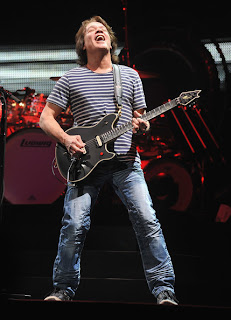
Eddie Van Halen is the master on the guitar, he alone is worth the price of the ticket. During the show goes at some point you realize: there is only one guitarist on that stage, playing all that music. Eddie dressed in jeans, along with a blue & white striped shirt, does it all. The most amazing part of his brilliance is the guitar solo toward the end of the show. He incorporates the classic Eruption, along with the effects from 1984 and performs some of the best guitar work ever see. I of course was in awe of Eddie's playing, but as I looked around I saw people with their jaws open, others staring just smiling & others just shaking their heads in amazement.
I just wished the solo was longer & their were more of them. Eddie looked happy all night as he just smiled sand backing vocals & played his guitar all night. He looked a bit bloated in the face, as if possibly his meds or his old drinking issues have had some effect on him.
I was very impressed at the backing vocals, I thought Eddie & Wolfgang did a fantastic job of it. That is a major part of the Van Halen sound behind that great music & although Michael Anthony is gone his backing vocal parts were covered well.
Alex Van Halen behind his dark sunglasses & huge silver drum kit, is an incredible rock drummer doing a fantastic job as usual. His drum solo was a great performance, as also added a latin percussion touch to it. It's amazing to see how musically talented the Van Halen family is. Edie's son (Alex's nephew) Wolfgang Van Halen, did a great job of bass playing & background singing himself. The kid is getting better & impressed.
Then at the front of it all is David Lee Roth. Roth is still all about himself, all about theatrics & having a good old time. He's what rock & roll front men are meant to be all about. Roth in his snake skin pants, velvet scarves, boots & beige hat is in incredible shape. He struts & dances all over the stage nonstop while telling stories & making jokes like a TV game show host. His high leg kicks are signature, as is his incredible twisted leg bending down thing he kept repeating the whole show. His voice is great he sounded fantastic.
.jpg)
Only problem I had with him was at times he seemed to change up the flow of some of the songs & change some of the words. At one point he forgot the words to the new Chinatown, as he confessed to the crowd. Another point he stopped the show & told the crew at MSG to shut down the blowers because it was ruining his vocals, as the air made his voice hoarse. Before the show I saw a wood board on the stage & the crew mopping some stuff on top of the wood. Turns out it was all for Roth to slide & dance across during the show.
The new songs were great live, it's a great new album no doubt, the first with Roth since 1984. I did think the sound could have been a bit better, maybe it was where I was sitting (section 107- Row 20). I also thought the set list could have been a bit better, although it was still great stuff. Tonight's show actually had a few different songs from what I saw on other nights & few songs were also switched around. Most notably the opener was switched to Unchained as opposed to You Really Got Me.
Madison Square Garden Set List 3/1/12
Unchained
Runnin' With The Devil
She's The Woman
The Full Bug
Tatto
Everybody Wants Some
Somebody Get Me A Doctor
China Town
Hear ABout It Later
Oh, Pretty Woman
Alex Van Halen Drum Solo
You Really Got Me
The Trouble With Never
Dance the Night Away
I'll Wait
Hot For Teacher
Women In Love
Outta Love Again
Beautiful Girls
Ice Cream Man
Panama
Eddie Van Halen Guitar Solo
Ain't Talkin' Bout Love
Jump
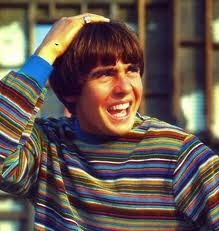
Today we lost a great actor/ singer / personality, the Monkees Davy Jones. I was a huge fan of the MONKEES, first as a kid watching the TV show reruns, after school & Saturday mornings. Then later I became a huge fan of their music. I have both seasons of the TV DVD box sets, Monkees cards & all their music as well as the mvie HEAD. They brought me alot of laughter & music in my life. I was very saddened to hear of Jones' passing today, I thank all of my friends & family who contacted me with the info all afternoon. may you daydream in peace forever davy...........
David Thomas Jones was born in Manchester, England on December 30th, 1945. Jones began acting on British Television by the time he was 11 years old. By his early teens, after his mothers passing he became a trained jockey riding horses. His trainer had a friend who worked in the Theater & when castings for the play Oliver began, they knew Jones was the guy. Davy played the Artful Dodger in Oliver at London & then on Broadway in New York, earning Tony Award nomination. On February 9th, 1964 his Oliver cast appeared on the Ed Sullivan Show the same night the Beatles were on making their American debut, changing the world forever. Davy later said that night as he stood on the side of the stage watching the girls go wild, he knew he wanted to do that.

Jones then signed a deal with screen Gems and had small parts on shows like Ben Casey & the Farmers Daughter. When the casting began for the Monkees TV show, Jones auditioned & got the part. He was perfect, as the short good looking English kid with the Beatle mop top & the good singing voice. He was funny, likeable, & the girls loved him. Jones became a teen idol, a sixties female heartthrob sensation.
The Monkees TV show was a huge success although it only had two year run at first, but then lived on for the next decade in reruns & Saturday Morning programming. The Monkees were the first of the sixties younger generation to make it into prime time breaking the barrier into the establishment. The wild zany rock band was a cross between the Beatles A Hard Days Night & the Marx brothers. Most of the rock bands of the day & the young people loved them, even if at first they didn’t play their own instruments. They broke through were funny, so they were hip. The Beatles themselves loved them; members of the Monkees were at Abbey Road studios during the Sgt. Pepper recordings, most famously the A Day In The Life session.
Eventually the Monkees took more control of their music, played the instruments & went on successful tours. They had some of the best writers of the day writing songs for them as well, Goffin & Carole King, Neil diamond, David Gates, & Boyce &Hart to name a few. And even more famously the Monkees would have a song play & the band would either be running around in a comedy skit or act out performing it live. The scenes were called romps & were the early versions of what eventually became music videos.
No matter what people say about The Monkees they were (& are) a very successful act. They were the first music artist to win two Emmy awards. In 1967 I’m A Believer was the #1 record of the year with Davys Daydream Believer the #3 record of the year. Their album More of the Monkees spent 70 weeks on the charts becoming the 12th biggest selling album of all time. In their hey day they had four number one albums in a two year span. They held the #1 spot on the album charts for 31 straight weeks (37 weeks overall). After their TV days, they experimented with the psychedelic cult movie classic, Head. The name was inspired with the thought of a sequel & the motto “from the people who gave you Head…..”

Davy Jones sand lead on Monkees classics; like Daydream Believer, Valeri, Laugh, I Wanna Be Free, She Hangs Out & Cuddly Toy. On the TV show every week, Jones would fall in love with a new sixties hot chick leading to some kind of zany comedy. After the Monkees Davy appeared on TV shows such as Love American style 7 the classic Brady Bunch episode where he takes Marcia to the prom. Jones appeared live as a solo tour & recorded as well. He & Mickey Dolenz & Peter Tork reunited the Monkees in 1986 with a new greatest hits album 7 a successful concert tour. The group got back for a few tours more recently last year on a fantastic reunion tour.
Davy Jones was married three times, his most recent wife Jessica many years his junior. He left behind four daughters &three grand children. He suffered an apparent heart attack on February 29th, leap year 2012 in Indiantown Florida. He was 66 years old. My most recent funny lasting memory of Jones happened last year on the Monkees Tour. When the group came out on stage, Davy said in all classic Monkee humor “Good evening I’m Davy Jones' father Davy will be out shortly. Shine until tomorrow Davy, thanks for bringing laughter & music to my life.
http://www.centerfieldmaz.com/2011/06/concert-review-hey-hey-were-monkees.html