Michael Joseph Donlin was Born on May 30, 1878 in Peoria, Illinois. His family moved to Erie, Pennsylvania where he lost both his parents in bridge collapse while he was still a young boy. Eventually he made his way out west to California & began to play baseball. He earned the nickname “Turkey Mike” due to the way he walked which resembled a turkey.
He was acquired by the National League’s St. Louis Perfectos (who became the St. Louis Cardinals) playing there in 1899 & 1900. He was an excellent hitter, batting over .320 both seasons but a poor defensive player. He decided to jump over to the American League going to the original Baltimore Orioles & played for manager John McGraw.
He ran into trouble getting arrested during a drinking binge as he waved a loaded revolver on a train. He served six months jail time up in Albany, New York. The Orioles released him, but the Cincinnati Reds picked him up for the 1902 season. The next year he hit .351, coming in second in the NL in hitting, posting a .420 on base %. He was in the league’s top five in most offensive categories becoming one of the game’s best hitters.
In 1904 he was having another great year when his heavy drinking got him arrested once again, leading to the Reds suspending him for 30 days. The events eventually led his old friend John McGraw to make a trade landing him with the New York Giants. He played outfield batting .280 in the last 42 games of the season, helping the Giants win the NL pennant. They didn’t play in the World Series that year because John McGraw refused to acknowledge the American League as an equal.
Turkey Mike loved New York; he was a heavy drinker & who loved to stay out late at night. He was a sharp dresser with dashing looks and always seemed to find trouble. He was popular with the women & was a real ladies man. One of his most famous quotes when night games first began was “Think of that, taking a ball player's nights away from him!"
Turkey Mike had one of his best seasons in 1905; he batted .356 (third in the NL) gathering 216 hits (second in the NL) while leading the league in runs scored (124). He posted a .415 on base % (fifth in the NL) stole 33 bases (8th in the league) nit 31 doubles (fourth in the NL) & had seven HRs which was good enough for third best.
The Giants won the pennant again, & this time went on to play in the World Series. John McGraw’s team beat Connie Mack’s Philadelphia Athletics in five games, as Christy Mathewson tossed three shut outs in one week. It was one of baseballs all time best pitching feats. In the Series Turkey Mike hit .263 (5-19) with a double, two walks and an RBI.
In April of 1906 he decided to settle down and married Vaudeville actress Mable Hite. He was hitting .315 after 37 games when he broke his ankle sliding into second base & had to miss the rest of the season. Turkey Mike still wanted to get paid the same salary in 1907 with a $600 bonus for staying sober.
Getting paid for not producing the previous year was unheard of in those days. Giant’s owner John T. Brush refused to pay & Turkey Mike sat out the entire season. Finally an agreement was made after pressure from fans & the press. He returned in 1908 & hit the game winning walk off HR on Opening day at the Polo Grounds.
Donlin picked up where he left off, coming in second in the league hits (198), was fourth in doubles (26) & HRs (6). He stole 30 bases (sixth in the NL) had 13 triples & scored runs, also in the leagues top ten. The Giants finished second to the rival Chicago Cubs, in the year of the famous year “Merkles Boner” play. Defensively Donlin had his finest year, posting a career best .977 fielding % & making just six errors in 155 games.
In October of 1908, Donlin & his wife Mable Hite wrote a one act play called “Stealing Home”. Turkey Mike made his acting debut as he casted himself in the play. Turkey Mike received mixed reviews, but critics raved over his wife's performance and the show became a huge hit. He claimed he made more money from this play then he ever did in baseball & he left the game, vowing to never to return. The show lasted for three years but after that Mable Hite couldn’t land any leading roles.
With lack of incoming cash, Turkey Mike returned to baseball and once again played for John McGraw. By now Donlin was 33 years old & was no longer the player he used to be. He was traded to the Boston Rustlers of the N.L. and finished the season batting. (234 at bats). In 1912 he played 77 games in Pittsburgh hitting .316 but resigned after the season.
In 1914 he returned to play 34 games with the Giants batting .161 before retiring for good. After a 12 season career he batted .333 lifetime (28th all time) with 1282 hits 176 doubles 97 triples 51 HRs 543 RBIs 213 stolen bases & a .386 on base %.
In 1912 his wife Mabel passed away after a bout with cancer. Two years later he married another actress; Rita Ross of the famed Fenton & Ross comedy team.
After his baseball days Donlin returned to acting but moved to the new form of entertainment; moving pictures in Hollywood. He had a number of small roles in the era’s silent movies including a classic starring Buster Keaton “The General”. He also starred in notable movies “Raffles, The Amateur Cracksman” (1917) and “The Sea Beast” (1926).
One of Turkey Mikes best friends and drinking buddies was the renowned actor John Barrymore who certainly helped his movie career. He was also used as an advisor on a number of baseball movies. Donlin passed away in his sleep from a heart attack at age 55 in Hollywood California.
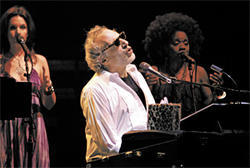
“Break out The hats & hooters”….. Steely Dan, a band that did not tour much during their hey days now seem to be a regular on the concert circuit every couple of years. They have found a home at the Beacon Theater on The Upper West Side of Broadway in Manhattan.
The Beacon is not my favorite venue, great location but the seating is rather high up in the loge area. We were in the first loge at a very high priced $150 ticket for being so high up. The seats are tightly close together, not enough leg room, rest rooms & a rather small lobby which is very tight at the start or end of the show. The sound can also be iffy, although it was pretty good last night.
No matter what economic times we live in the huge Steely Dan fan base are loyal and always come out. Last nights show was the fourth of seven sold out nights at the Beacon on their Shuffle Diplomacy 2011 Tour. Each night at the Beacon has a different theme usually where an entire album is played, on the fourth night it was the classic 1977 five million selling Aja album.
Steely Dan is made up of Upper East Side resident, Donald Fagan the multi keyboardist, piano player, lead vocalist & main song writer. He is a perfectionist, pays very close attention to detail & on stage is the leader of the whole show.
His longtime partner, Queens born Walter Becker handles the guitar work on stage rhythm as well as some lead. Becker also has written with Fagan, played bass, as well as produced may Steely Dan & solo Fagan projects through their career.
The current tour lineup playing as clean & meticulous as Steely Dan music can be played, were just flat out- great. The Miles High Big Band (as they are called) features long time Steely Dan touring guitarist Jon Herington (2000-1022) who once again was phenomenal, the popular Keith Carlock who was just as incredible on drums, Jim Beard on keys & Freddie Washington on bass.
The fantastic horn section included; Michael Leonard (trumpet) Jim Pugh (trombone) Roger Rosenberg (baritone sax) & Walter Weiskopf (sax).
Helping Fagan on the legendary Steely Dan female vocal arrangements are “the Embassy Brats” featuring the lovley Carolyn Leonhart Escoffery, who has been with Steely Dan on Tour & on record since 2000.
Along side Carolyn were Cindy Mizelle & Catherine Russell. The girls were sensational, also doing a remarkable performance when they alternated the lead vocals on the classic “Dirty Work”.
Fagan’s voice was certainly a bit overworked as it sounded very hoarse. The girls really helped him out last night carrying his hoarse voice through some rough spots, although to his credit he carried on without missing a beat. Fagan of course was fantastic on piano & the various key board instruments he played. A fully bearded Walter Becker was great on guitars, and he even gave us a bit of storytelling during “Hey Nineteen” as well as doing the band intros.
The show opened with The Sam Yahel Trio doing a half hour set & then the Miles High Big Band doing an Intro called Dizzy’s Bidness. It followed by Fagan & Becker taking the stage to a huge ovation from the mostly over forty crowd.
Carolyn Escoffey then walked over to the front right side of the stage & placed a record on a phonograph, as the band started out the Aja album. (By the way she did turn it over after side one was complete.)
It was an enjoyable extra long show, as people who were at other nights said those shows were shorter. The band gave the crowd their money’s worth playing well over two & a half hours. Highlights for me were Aja, Home At Last, Bodhisattva, My Old School, Reelin in the Years, Kid Charlamagne & the rare live performance of Riki Dont Lose that Number.
Steely Dan Set List- 9/19/11
Dizzys Bidness (intro)
(Aja album in it's entirety)
Black Cow
Aja
Deacon Blues
Peg
Home At Last
I Got The News
Josie
Your Gold Teeth
Black Friday
Lunch With Gina
Hey Nineteen
Riki Don’t Lose That Number
Show Biz Kids
Godwhacker
Time Out Of Mind
Papa Don’t Take No Mess
Dirty Work
Bodhisattva
My Old School
Reeling In the Years
Encores- Kid Charlemagne
Last Tango In Paris
Robert Allen Murphy was born September 19, 1924 in Oklahoma. Bob spent fifty years doing play-by-play of MLB games on television and radio. 41 years of those years were spent with his beloved New York Mets, from their inception in 1962 until his retirement in 2003.
Murphy’s first broadcast job was in the minor leagues, with the level D Muskogee, Oklahoma Reds. His first major league job was with the Boston Red Sox in 1954, working with the legendary Curt Gowdy. Murphy stayed in Boston broadcasting the Red Sox for six years, seeing them finish a highest of third place twice. He then moved to the Baltimore Orioles for two seasons 1960-1961. His call of Roger Maris' record-tying 60th HR in 1961 was what he used as an audition tape that landed him a job with the expansion New York Mets in 1962.
Quotes: Bob’s introduction to the New York Mets went like this in 1962-“This is Bob Murphy welcoming you to the first regular season game in the history of the New York Mets. Tonight the New York Mets meet the St. Louis Cardinals right here in St. Louis.”
Murphy would be part of a three man rotation of announcers, along with Lindsey Nelson & Ralph Kiner. The trio would broadcast Mets games on the radio & on television through the 1978 season. They would usually do three innings of work each on WOR Channel 9 TV, then switch to the radio booth. The three would also narrate the Mets highlights films after each season, and do commercial spots for various sponsors. Who could forget Murphy’s classic spots for Rheingold & Schafer beers throughout the Mets history?
Murphy became known for his optimistic & positive outlook on the game. He would almost never criticize the players & always tried to fins the good in a situation. Everyone knew he was happier when the Mets won, but he would not openly root for the team in any way. Only in the end after each Mets win would he say “we’ll be back with a happy recap in just a moment”.
His love for baseball would have him equally excited when a fine play was made by the visiting team just as if it was made by the Mets. He was said to have painted a picture of each baseball game he broadcast with his own words & his unique delivery. Somehow with Bob Murphy who never seemed to get to down, you always had a feeling the Mets could comeback when you heard his voice.
Murphy reported the Mets through the early years at the Polo Grounds as the fan base grew. He then found a seat in the grand new ballpark known as Shea Stadium in 1964 with the World’s Fair as it’s neighbor in the background.
By 1969 Murphy was there for the Amazing Mets as they shocked the baseball world winning the World Series. He was at the mic in the 9th inning at Shea Stadium on July 9th for Tom Seaver’s famous imperfect game; "And it's hit hard to leftfield...It's going to be a base hit...A base hit by Jimmy Qualls and it breaks up the perfect game...Now the applause for Tom Seaver...Eight and one third innings of perfect baseball by Seaver."
On September 24th he made another famous call as the Mets won the Eastern Division. "The crowd is chanting, 'We're number one!' The Mets made up fifteen-and-a-half games since the 13th of August. Lou Brock is on second, and Vic Davalillo, the runner on first with one man out...ninth inning, 6-0, New York. Gentry pitching, working hard here against Joe Torre. Now in the set position, here's the pitch...ground ball hit to shortstop...Harrelson to Weiss, there's one, first base...Double play...The Mets Win! It's All Over! Ohhhh, the roar going up from this crowd! An unbelievable scene on the field...fans are pouring out on the field."
Murphy's joyous voice filled the airwaves again in 1973 as the Mets rose from the cellar at the end of August to the coming within one game of winning another the World Series. It was the year of "You Gotta Believe” & all throughout 1973, Murph's voice seemed to be there for each dramatic moment. From the ball off the ball play at Shea Stadium in late September to out that clinched the NL Pennant as John Milner flipped to Tug McGraw in the rain at Wrigley Field on the last day of the season.
"Now the stretch by McGraw...the 3-2 delivery...the runner goes...a little pop up...Milner's got it...he'll run to first...Double play! The Mets win the pennant! The Mets have just won the pennant in the Eastern Division! It's all over! They won the pennant with a magnificent stretch drive." – In the NLCS against the Cincinnati Reds it was Bobs call on the radio to the New York fans that let everyone know “a fight breaks out at second base”.
In his voice you heard the surprise & the disgust as he mentioned how much bigger Pete Rose was than little Bud Harrelson “Rose outweighs Buddy Harrelson by about thirty five pounds”. Murphy called the classic Game #5 as the Mets won the pennant & went to the World Series falling one game short of another miracle.
Murphy continued to broadcast the Mets through the seventies as the team that was once a family had changed. Tom Seaver was gone & the Mets fell into last place. Broadcast partner Lindsey Nelson left New York for the west coast San Francisco Giants in 1979 he was replaced by Steve Albert for three seasons.
Prior to 1982, the Mets announcers had done television and radio on a rotational system. When one was on TV, another would take over on radio, and the other would take a three inning break. As a general rule, the Mets did not have two men in the broadcasting booth, as is so common today.
In 1982, Murphy was taken out of the television booth, and placed soley on the radio. He was joined by Steve Lamar that season who also strictly did radio for the Mets broadcasts. At first Murphy wasn’t happy about being exiled into radio, but with his class he never complained, took on the job & mastered it.
Many say that play-by-play of baseball on the radio requires a lot more skill than on television, because the broadcaster must be able to inspire the listener's imagination. This is where Bob Murphy was the master, from his description of the weather at the ballpark to the size of the crowds, you saw it through Bob’s radio eyes. Murphy like a great artist was even able to paint the perfect picture of baseball right down to the puffy cumulus clouds on warm sunny days. For the rest of his career, with the exception of a few emergency situations, he announced exclusively in the radio booth.

In 1984 he was inducted into the New York Mets Hall of Fame. Bob truly took over as the voice of summer for Mets fans as the team once again became contenders in the mid eighties. From the steady play of Keith Hernandez, to the monstrous HRs of Daryl Strawberry to the phenom pitching of Dwight Gooden, it was Bob’s voice who brought it to us. By 1986 the Mets were the best team in baseball and were back in the postseason for the first time in 13 years, and it was Bob Murphy whos voice is remembered with its biggest thrills.
"Lenny Dykstra, the man they call Nails on the Mets ballclub is waiting...Now the pitch and it's a high fly ball hit to rightfield...It's fairly deep...It's way back, by the wall...A home run!! A home run!! The Mets win the ballgame...Dykstra wins it...Len Dykstra hit a home run...This ballgame is over...Lenny Dykstra is being mobbed by his teammates." - Murphy's call of Lenny Dykstra's ninth inning game-winning home run at Shea which gave the Mets a 6-5 win over Houston in Game Three of the 1986 NLCS.

"Mookie Wilson still hopes to win it for New York...3-2 the count...And the pitch by Stanley...And a ground ball trickling...It's a fair ball. It gets by Buckner! Rounding third is Knight...The Mets will win the ballgame...They win! They win!" - Murphy's call on October 25, 1986, of one of the most classic moments in Mets & World Series history. Game Six of the 1986 World Series as New York rallies to beat Boston, 6-5, in 10 innings, to tie the Series at three games apiece on October 25, 1986.
"Now the pitch on the way...He struck him out...Struck him out! The Mets have won the World Series! The dream has come true. The Mets have won the World Series coming from behind to win the seventh game." - Murphy's call of the final out of the 1986 World Series which gave New York its second title on October 27, 1986.
Bob witnessed more than 6,000 Mets games and was behind the microphone for the club's six trips to the post-season and two World Championships. In his own words Murphy said, "It's hard to single out one game, but Game Six of the 1986 NLCS at Houston is one that stands out for me," once noted Murphy.
Murph went through those Mets glory years with another fine announcer at his side Gary Thorne. He got to another Eastern Divisional title in 1988 with his new broadcast partner Gary Cohen. As some more down years followed in the 1990’s Murphy received the Ford Frick Award & earned a spot in the broadcaster’s wing of the Baseball Hall of Fame. At Shea Stadium the Mets named the radio booth the Bob Murphy Radio Booth in his honor.
In the twilight of his career Murphy got to see the Mets get to two more post seasons including a Subway World Series in 2000. In 2002 the radio booth in Shea Stadium was renamed the Bob Murphy Radio booth in his honor. As the new millenieum rolled in he was aging, his eyes & his health began to go down hill. He no longer sounded like the smooth broadcaster he once was.
At a game against the Cincinnati Reds I was at in 2003 he announced his retirement at the end of the season. In the final home game of the 2003 season, the Mets honored him on Bob Murphy night September 25, 2003.
On July 25, 1990 at Veterans Stadium in Philadelphia, the Mets took a 10-3 lead into the ninth inning. But the Phillies opened the inning with seven consecutive singles, a walk, and scored six runs to narrow the Mets lead to one run. Finally the Mets were able to turn a double-play and get a line drive out. By the end of the inning Murphy showed a rare display of emotion as his patience had worn thin. As the game finally ended, he famously said, "The Mets win! They win the damn thing by a score of 10 to 9!" The use of an almost bad word was so out of character for Bob that it was became one of his more memorable moments following his retirement.
After the 2003 season, Murphy retired to sunny Florida. He passed away of lung cancer in August of 2004 in West Palm Beach Florida at the age of 79. After his passing, the Mets honored Murphy's memory by wearing a patch on the left sleeve of their uniforms for the rest of the 2004 season.
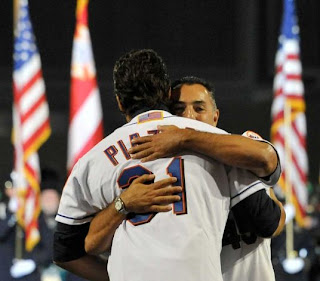
A standing room only crowd including hundreds of Mets fans jammed St. Patrick's Cathedral for Bob’s memorial service. Mets owner Fred Wilpon led a both current players like Mike Piazza and Al Leiter as well as former Mets Keith Hernandez, Ed Charles and Bud Harrelson. Wilpon and broadcaster Gary Thorne delivered the eulogies. "For 42 years, he was with us for every beautiful summer's day," Wilpon said. "His impact on Mets fans will live on for generations."
Quotes: Gary Thorne,former Mets broadcaster& ESPN announcer; “He was my former radio partner with the Mets, a Hall of Fame announcer and a good friend. In his memory, all of us who love the game might remember just what made Bob and his band of broadcast brothers such a joy to hear. They put the game first. They cared about their listeners.
They painted the word picture for the enjoyment of their audience, In 50 years of broadcasting, Bob Murphy left behind a treasure chest of memories. He showed us all how powerful words can be when they're spoken by one of the great voices of the game.”
Gary Cohen-Mets Broadcaster: "What stands out the most about Bob is the first game I ever broadcast for the Mets, in 1988. I was filling in for one night and I was a minor-league kid who had looked up to Murph from the time I was 6 years old. I was petrified, to put it lightly.
At one point early in the broadcast, I just froze. I didn't know what to say or do next. Murph reached out with his hand and patted mine and took over, making the rest of the evening easy. He was a very sweet man. He made sure that I was comfortable and that I could function and succeed, and I'll never forget that."
Trivia: Murphy was also an announcer for the New York Titans (now the New York Jets) of the American Football League (before they joined the NFL. In addition, in 1973, he hosted the New York edition of Bowling for Dollars, a locally-produced game show, on WOR-TV.
His brother Jack Murphy was a sports writer who was instrumental in bringing MLB to San Diego. The former Padres home Jack Murphy Stadium was named in his honor.
from centerfield: For me there was no more favorite of announcer than Bob Murphy. As a kid I grew up with Bob from the Miracle of '69 through the pennant of '73, he brought it all to life for me. I remember seeing him leave the ballpark once when I was a kid & he seemed like a star as got into a private car driving off.
Later as I got older in the late seventies I remember ding impressions of his voice in school as the Mets fell into bad time "It's beautifal daaaaaay for baseball" (in a classic Bob voice). Then again in the partying days of the mid eighties me & my friends would once again imitate Bobs voice with more of an adult humor added to it.
Then as I got older it just became such a pleasure listening to Bobs broadcasting, like a work of art. I would keep the TV's voice off sometime & put Bobs radio calls on instead. He is greatly missed & was a huge part of my Mets history.
The Mets did a fantastic job of honoring 911 on the tenth anniversary at Citi Field. The Mets players along with eight New York City agencies lined the foul lines in a touching pregame ceremony. MLB & Joe Torre denied the team the right to wear FDNY / NYPD caps in place of their usual Mets caps.
2001 Mets Pitcher & native New Yorker John Franco threw out the ceremonial first pitch to Mike Piazza. Also on hand from the 2001 team were manager Bobby Valentine who was on hand broadcasting the ESPN nationally televised game in honor of the anniversary. Robin Ventura, Todd Zeile & Steve Trachsel were also on hand to escort the honored guests onto the field.
Former Met Rusty Staub who's organization The New York Police and Fire Widows' and Children's Benefit Fund has donated more than 115 million dollars since 911 was also on hand.
here is the link from the Mets site of the ceremony: http://newyork.mets.mlb.com/news/article.jsp?ymd=20110911&content_id=24568022&vkey=09112011&c_id=nym
Here is the emotional Mike Piazza pre game interview with Bobby V. alongside as well: http://search.espn.go.com/piazza/video/6
Grant William Roberts was born September 13, 1977 in El Cajon California. Roberts was a tall right hander, drafted by the New York Mets in the 11th round of the 1995 draft. His career began as a starter going 9-1 in his second pro season at Kingsport in the Rookie League.
In 1997 he was the South Atlantic League’s pitcher of the year going 11-3 posting a 2.36 ERA while averaging nine strikeouts a game. He needed elbow surgery the next season and was never the same pitcher again.
He converted to a reliever and was promoted to the Mets staff in the 2000 NL Pennant season. He made his debut on July 27th against the Montreal Expos and got knocked out of the game in the 2nd inning after giving up six earned runs, six hits & three walks. In September he appeared in three more games, including a four inning one hit performance on the last day of the season.
Roberts did not appear in any post season games. His ERA for the year was 11.57 allowing nine earned runs over seven innings. He was a middle reliever for the Mets over the next four seasons, enjoying his best year in 2002 going 3-1 with a 2.20 ERA, striking out 31 batters in 45 innings. In June his ERA was 0.59 but then he suffered rotator cuff problems that sidelined him for two months.
Drama: That summer Newsday published a photo of him that was taken back in 1998, as he was smoking marijuana from a bong. He was also linked to pot smoking during that season with a few other of his team mates. Roberts claimed in his defense, that the picture came from an old girlfriend who was trying to extort money from him.
In 2003 injuries kept him out until August, when he returned to get credit for a save & four holds, but went 0-3 with a 3.79 ERA. In 2004, his Spring Training went well & he was being considered for a starting role by pitching Coach Rick Peterson.
But then another rotator cuff injury did him in for good. He only pitched in four innings all year, allowing nine earned runs, which included giving up two HRs. He was released that winter and came up dirty for steroid use. He got suspended along with seven other minor leaguers, missing more action.
In May of 2005 the AL NY team signed him, but he was released three months later ending his career. A once promising career was ruined by injuries, pot smoking, steroid use & scandals.
Overall in his five year career he made 76 appearances going 4-4 with one save 77 strike outs 37 walks in 101 innings pitched posting a 4.25 ERA.
On September 11th 1974, a little over 13,000 fans came out to Shea Stadium to see Yogi Berra’s fourth place take on manager Red Schoendienst’s St. Louis Cardinals.
The Mets were still the reigning N.L. Champions but their days were numbered as they were eleven games behind the Pittsburgh Pirates. The Cardinals were in heavy pursuit of the Pirates just 2 ½ games back, alive & well in the pennant race. (The Pirates would win the East in 1974 but lose to the L.A. Dodgers in the NLCS) Jerry Koosman (13-9) was the clubs top pitcher, as Tom Seaver was struggling all year with back issues & mechanics problems. Koos took the mound for the Mets going against the Cards Bob Forsch.
The Cardinals Lou Brock had just set a modern day single season record for stolen bases (105) the night before in St. Louis, breaking the Dodgers Maury Wills old record of 104. A young Keith Hernandez was in the Shea visiting dugout and had only played in five career MLB games going 4-11 (.364) since his debut on August 30th. The Mets leading hitter in 1974 was Ed Kranepool while the John Milner & Rusty Staub were the teams leading power hitters.
Koosman got himself in trouble early on walking two batters in the first inning and allowing an RBI single to Joe Torre. The Mets came right back as Felix Millan reached on an error & then was forced by Cleon Jones. Jones reached second on a wild pitch & scored on a John Milner double.
The score remained tied into the bottom of the 5th inning when Cleon Jones hit a two run HR putting New York up 3-1. Koosman rolled along allowing just the one run & three hits until the 9th inning. He then allowed a double to Ted Simmons but also struck out Joe Torre & Bake McBride. Then with two out, Cardinals third baseman Ken Rietz blasted a game tying HR over the Shea Stadium fence.
The Cardinals relief ace Al Hrabosky shut down the Mets’ Don Hahn, Duffy Dyer & Teddy Martinez in the 9th inning as well as the next two innings. The Mets brought in Harry Parker who kept St. Louis in check for three innings including getting pinch hitter Keith Hernandez to fly out to lead off the 12th inning.
In the top of the 13th inning, Mets pitcher Bob Miller (who was a member of the both the 1962 original Mets & the 1973 pennant team) took the mound. There was some excitement when Joe Torre who had walked attempted to score on a base hit by Bake McBride, he was nailed at the plate on a series of relay throws from Cleon Jones to third baseman Wayne Garrett to catcher Duffy Dyer who made the tag.
The Mets left two men on base in the bottom of the 13th when former Mets pitcher Rich Folkers, got pinch hitter George “the Stork” Theodore to ground out. The Mets left rookie Dave Schneck at second base & Don Hahn at first. In the 14 inning the Mets threatened again, when Bud Harrelson walked & was sacrificed over to second by Felix Millan.
Next Cleon Jones was intentionally walked but Pitcher Claude O’Steen retired John Milner & Wayne Garrett. O’Steen would pitch nine innings of relief striking out five Mets allowing just four hits along the way. Bob Apodaca pitched three scoreless for the Mets handing the ball over to rookie Jerry Cram who would then pitch eight innings of relief. Cram allowed seven hits & four walks while stranding eight Cardinal runners escaping trouble each time he got into a jam.
In the top of the 20th inning, catcher Ron Hodges now behind the plate, was involved in an obstruction call on an at bat by Joe Torre. Yogi Berra came to argue the call & was ejected from the game by home plate umpire Ed Sudol. In the top of the 24th Joe Torre involved in another game highlight singled with two runners on but no one was able to score, Cram then got Dick Billings to ground out.
In the bottom of the 24th inning the Mets looked as though they were going to pull off a win. With two out Dave Schneck (who led all players with 11 official at bats that night) doubled. Next pinch hitter Jim Gosger was walked intentionally & catcher Ron Hodges also drew a walk. The Mets leading RBI hitter, Rusty Staub who had been sitting on the bench nursing an injury, came up as a pinch hitter to the excitement of the remaining Shea crowd. Unfortunately Staub grounded out to end the inning.
In the top of the 25th inning Yogi Berra brought in the Mets sixth pitcher of the night, September call up Hank Webb. Webb had been the second best pitcher at AAA Tidewater behind Randy Sterling going 10-8 for the Tides. The Cards Bake McBride led off the 25th with a single, his fourth hit of the night & then all hell broke loose. Webb attempted to pick off the speedy McBride but threw the ball wide of first base. John Milner chased the ball all the way to the outfield as McBride circled the bases. Milner threw home but McBride scored on another error by catcher Ron Hodges. It of course turned out to be the winning run.
In the bottom of the 25th inning, Ken Boswell & Felix Millan were both retired quickly. Then with two outs, the legendary early seventies yearbook prospect Brock Pemberton got his first career hit, a pinch hit base hit in just his second career game.
Future Mets pitcher Sonny Siebert, then struck out John Milner to end the game. After seven hours & four minutes the line score read Cards four runs 18 hits two errors, the Mets three runs 16 hits four errors. Mets pitchers struck out twelve batters while walking eight & Cards pitchers struck out sixteen batters while walking eleven.
The Mets used 24 players while the Cards used 26 players. When the game ended the big Longines clock on the Shea scoreboard read 3:07 AM. For the record, It is the second longest game in history in terms of innings (25). The Mets as a team have played in four games of the 42 games in MLB history lasting twenty or more innings. Also that night at Shea in attendance was Commisioner Bowie Kuhn with his family, he was reported as staying for the whole game.
Edward Lawrence Sudol was born on September 13th, 1920 in Pasaic New Jersey. He attended Farleigh Dickenson University at Rutherford long before NFL football arrived in the area. He played minor league ball through the forties in various farm systems. He batted over .300 twice, while playing mostly as a firstbaseman. By 1953 he retired from playing & began to umpire. He first worked in the Tri State League, then the AAA International League from 1955-1957 when he got called up to the big leagues.
Sudol was a National League umpire from 1957-1977 working three World Series & many classic baseball games. He was the home plate umpire in the 1965 World Series for Game #4 at Dodger Stadium as Don Drysdale beat Mudcat Grant striking out nine Minnesota Twins.
Sudol also worked the 1971 World Series, serving as the home plate umpire in Game #2 at Baltimore’s Memorial Stadium as the Orioles hosted the Pittsburgh Pirates. Sudol worked his third & final World Series in his final season, 1977.
He worked behind the plate in Game #2 in New York as the Dodgers beat the AL New York club 6-1 on HRs by Steve Garvey, Ron Cey, Reggie Smith & Steve Yeagar. Sudol was also on the field umpiring in Atlanta in 1974 when Hank Aaron broke the all time HR mark.
Sudol played a part in some classic New York Mets games as well. On May 31st, 1964, he came to a brand new Shea Stadium, to work a double header. He arrived at the ballpark at 11:00 AM & would not leave until two the next morning.
He was working behind the plate for the second game which would last seven hours & 23 minutes. The game started out between with the San Francisco Giants sending out Bobby Bolin to pitch against Bill Wakefield & the New York Mets. Twelve pitchers would take the mound during the day and a total of 42 players would participate in the game.
The Mets would come from behind 6-1 to tie the game on Joe Christopher’s three run HR in the 7th inning. The score would remain that way (6-6) for sixteen more innings until Del Crandal & Jesus Alou drove in runs off the Mets Galen Cisco in the top of the 23rd.
Less than a month later he was behind the plate again at Shea Stadium on Father’s Day 1964 as the Phillies Jim Bunning pitched a perfect game against the New York Mets. Sudol said the pressure was on him as well, as he was aware of the perfect game all along because the giant Shea scoreboard staring right at him the entire game.
On April 15th, 1968 Sudol worked home plate at the Houston Astrodome in a game between the Mets & the Astros. Tom Seaver pitched 10 innings of two hit shut out baseball for New York & Don Wilson pitched nine innings of shutout five hit ball for Houston. Neither pitcher would be around for the end, as this game took six hours & six minutes, as well as 24 innings to finish. In the bottom of the 24th inning, Houston’s Bob Aspromonte hit a ground ball to Ed Charles at third base; Charles made an error allowing the winning run to score from third base.
Sudol worked the 1973 NLCS between the New York Mets & Cincinnati Reds working home plate for Game #1 in Riverfront Stadium. It was a classic pitchers duel in which Tom Seaver allowed just one run on five hits until the bottom of the 9th when he allowed a walk off HR to Johnny Bench. The Reds Jack Billingham held the Mets to just three hits, their only run driven in by a Tom Seaver double.
If this wasn’t’ enough, Sudol had one more 25 innings epic game involving the Mets & St. Louis Cardinals at Shea Stadium on September 11th 1974. (see centerfieldmaz article above) Sudol said when he worked games in New York he stayed with his mom at his old house in Pasaic, NJ.
For this game his brother attended & stayed the entire game. Afterwards they went to a diner & it took him twenty minutes of walking around the parking lot to shake off the cramps from his legs. That night Sudol was hit by foul balls seven times, he never left the field & got home at 5:00 AM.
In another classic Sudol Umpire event, during an NBC Saturday afternoon Game of the Week played at Wrigley Field in Chicago in 1969, he stripped down to his wearing his protective gear over just a white under shirt.
It was a hot humid day & as the other umpires took off their jackets umpiring in official umpire shirts, Sudol just wore his Tee.
Sudol eventually retired to Daytona Beach Florida, enjoying like in sunny Florida. He passed away in 2004 at age 84 after a bout with Alzheimer’s.